DC Comics: Fixing The Problems
Reading time: 7 minutes
VIDEO UPDATE 4/2/13:

Last week, I wrote a piece identifying some of the many problems that DC Comics has had since the New 52. Many voiced their concern wondering what a healthier version of the company could possibly look like. After spending some time researching, the following conclusion seemed crystal clear to me. DC needs to establish new characters before giving them their own ongoing series right away. Also, the company is not giving writers the freedom they need to tell the stories they want to tell, as evident by recent talent firings. A strong voice also needs to be established to speak to the fans in order to abolish the bizarre continuity errors in the universe. Often the new waves of titles from the House of Batman have felt like a random grab bag of different comic book series that have inappropriately been selected for release and confusingly branded as a coherent new wave. The talent firings from editorial have been a massive misstep, causing a lack of interesting titles from the publisher and many missed opportunities for good comics. The publicity angle has also not been a factor up to this point, instead we have gotten mixed and muddled messaging from Jim Lee and Dan Didio, the co-publishers of DC Comics. James Burell had brought to my attention that I may have been missing the point entirely, as Bob Harras was appointed as the Editor-In-Chief of DC in 2010. It seems slightly too suspicious that he was the Editor-In-Chief of Marvel Comics towards the crash years of 1995 to 2000. More on that later.
At this point, the breaks can’t be successfully hit on the New 52. Rebooting the universe would only serve to confuse those that were already confused. To address certain issues like the ones listed above, a middle man involved in fan relations would be a massive leap forward for the company. Co-publishers Lee & Didio have tried to fill that role along with Chief Creative Officer Geoff Johns. While these three people are likable enough, I believe they may be too close to editorial, in order to really understand how the current fan perception of the company is. Obviously, beefing up public relations is not a strategy comics companies typically utilize. The big two haven’t seen something of that great an effect since the 60’s with a cheerleader like Stan Lee. Having someone serve as a big consultant to all the major comic news outlets that is extremely happy to talk to fans. For instance Kaz Hirai has been the start of some real change at the gaming leg of Sony, that currently has devoted legacy fans that are extremely happy with the product and branding. Hirai is regarded as a sort of charming movie star that fans are excited to hear from everytime he walks in the lime-light. Can anybody imagine what a DC Comics equivalent to that person could possibly look like?
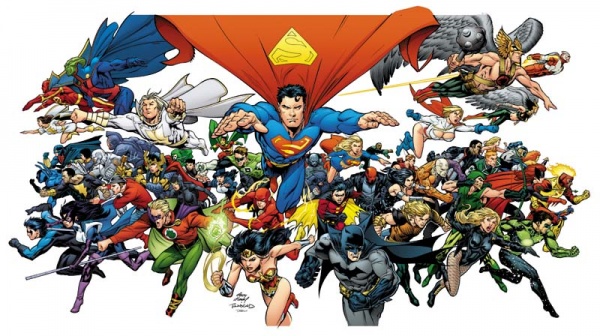
How many random DC Comics have been thrown into the wild just to see what could possibly stick to the wall? Here are a just a few examples, Amethyst: Princess Of Gem World, Katana, Vibe, Infinity Inc., Justice League International, and the Wildstorm properties. Throwing legacy characters such as these in a minefield of already established intellectual properties equates to certain doom. For instance take a look at how author Geoff Johns organically crafted the Green Lantern & Aquaman legacies. The creative legend has carefully cleaned up the mythology of both franchises to the point where now they all have at least two separate series hitting the stands.
So what do these comics have that these others do not? For one, a long term publishing plan and a very committed fan favorite creator. Green Lantern and Aquaman may not be F-list characters like Amethyst, but they needed reworked nonetheless. Also, putting A-list talent on characters that are guaranteed to sell only makes sense to a certain degree. Johns was just announced to chronicle the exploits of Superman, which is a character who is currently in need of the author’s particular skill set. He provides the writing duties for something like the Justice League, which is an already established DC money maker. I would argue that he should instead tackle one of the above properties, and really begin to clean out some of the trouble spots within the company. Putting F-list characters on team books and immediately launching new ongoing series with talent that is not established may not be doing anything good for DC in the long run. That being said, putting some of these heroes on team books cannot hurt for sales. Another aspect that could really help the smaller heroes is basing a line wide event around them, or placing them in some sort of wider continuity arc. Obviously, that attempt was tried with Pandora with mixed results, but it can be argued that she wasn’t quite established enough to directly pull off an ongoing only starring her. DC did a great job waiting until people truly cared before they launched the new Batwoman title.

Here is Mark Waid on how he feels about the recent handling of the Legion franchise, another batch of F-list characters that DC has been publishing for a longtime.
Holy shit, did DC just end the Legion franchise after 40 years of continuous publication? #AnotherProudNew52Moment
Finally, there is one integral puzzle piece that is necessary to get DC Comics back into fan priority for my hard earned dollar. The publisher needs to work on accommodating the talent for the long term. From what we understand with creators like Robert Liefeld, Joshua Hail Fialkov, J.H. Williams III, and W. Haden Blackman is that there is some strange problem with editorial. Readers know that there is something strange happening with editorial at the company. Here is a sampling of those citing editorial as their issue over leaving DC.
Reasons are the same as everyone’s that you hear. I lasted a few months longer than I thought possible. Massive indecision, last minute and I mean LAST minute changes that alter everything. Editor pissing contests… No thanks. Last week my editor said ‘early on we had a lot of indie talent that weren’t used to re-writes and changes … made it hard.’ Uh, no, it’s you.
J.H. Williams III & W. Haden Blackman:
Unfortunately, in recent months, DC has asked us to alter or completely discard many long-standing storylines in ways that we feel compromise the character and the series. We were told to ditch plans for Killer Croc’s origins; forced to drastically alter the original ending of our current arc, which would have defined Batwoman’s heroic future in bold new ways; and, most crushingly, prohibited from ever showing Kate and Maggie actually getting married.
There were editorial decisions about the direction of the book that conflicted with the story I was hired to tell, and I felt that it was better to let DC tell their story the way they want.
As you can tell, editorial seems like a big point of contention with all of these different creators. What can DC do to fix this massive problem that has led to the departure of so many? The answer seems so simple: leave them alone. Mark Waid is universally heralded as a great creator in the industry right now, and it is obvious that he loves both DC and Marvel, so why is he only working at one company over the other right now? While readers will never truly know, there are several crude accounts of Marvel in the 90’s not being a great environment to work at when Bob Harris was Editor-In-Chief. In order to craft any kind of story with these different heroes and villains in the New 52, there has to be a certain amount of give and take with the creators. These are established money making properties, so automatically killing them off is financially unrealistic; the creators need more leeway to craft interesting tales.
There is only a certain amount of stories that can be told when playing by the rules with any character. In a specific case like J.H. Williams III and W. Haden Blackman’s Batwoman, there was a real sense of attempting to widen the scope of the series and character. A direction for Batwoman which was that ambitious should have been celebrated; instead it was cut short before a grand crescendo. Finally, there are several things that publishers could do in order to be more courteous to the creators; these include giving royalties to those that have contributed to something that is going to be adapted to other media. Marvel is atleast letting talent that made these characters come back and work for them, such as Jim Starlin returning to Thanos, or Dan Abnett and Andy Lanning going back to the Guardians Of The Galaxy.

After considering all of the above, some may perceive that DC is in a truly dire state right now. The truth is that they are not. The company is making more money than they have been in quite sometime. The main point here is that several smaller ideas could equate to a stronger DC over the course of a few months or years. If there is any change, it is going to happen very slowly. There have been certain decades or years where one of the publishers makes a bad decision or goes through a rough patch such as this one. There will be a sort of ebb and flow with publishers that have been around for such a long time. If you are reading this DC Editorial, give creators freedom, put established talent on small books, and be patient!
Support Us
Enjoyed this article?
Supporting us on Ko-fi helps keep Comic Book News UK running and lets us continue championing indie comic creators across the UK. Every contribution makes a real difference.

100% goes towards supporting indie creators